

Chronicle of a unique meeting against food loss and waste
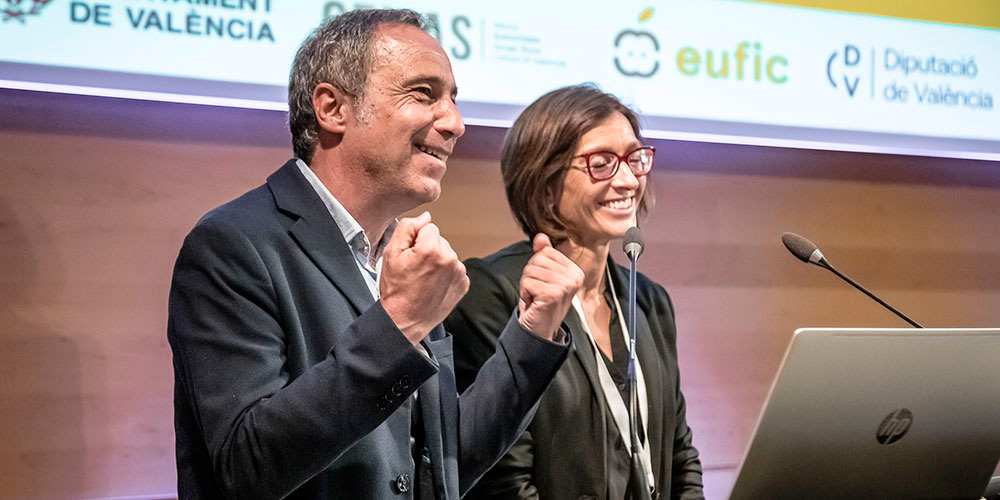
On 3 October 2023, CEMAS and the European Food Information Council (EUFIC) brought together experts from around the world for a momentous event at the Palacio de Congresos de València. The meeting sought to address one of the biggest challenges facing the food sector: food loss and waste. The aim? To explore solutions from a global and cross-cutting perspective to build a more sustainable future. Join us for a tour of the event organised as part of International Food Loss and Waste Awareness Day and find out how cities and citizens are key in the fight against food waste. Here we go!
A call for global action
The event was opened by the Councillor for Agriculture of Valencia, Carlos Mundina, the director of CEMAS, Vicente Domingo, and the director general of EUFIC, Laura Fernández. Mundina proudly recalled that in just a few months València will hold the title of European Green Capital in 2024, a commitment to “generate dynamics that will allow us to continue being a city committed to a more sustainable future”.
The home: a critical point
A striking fact highlighted at the conference was that more than half of all food waste occurs in our own homes. Both Vicente Domingo and the Director General of EUFIC stressed the responsibility of administrations to raise awareness among families and individuals. This is where we can all make a difference.
World experts share visions
The day featured keynote speakers, including Raschad Al-Khafaji, Director of FAO Brussels; Juan Prieto, Deputy Permanent Representative of Spain to FAO; Anne-Laure Gassin, Team Leader of the Directorate General for Health and Food Safety of the European Commission; and Felicitas Schneider, researcher at the Thünen Institute and a world authority on the fight against food loss and waste. Schneider underlined that significant reduction of food loss and waste requires the commitment of all actors involved and emphasised the importance of public-private cooperation and the crucial role of cities in this mission.
National policies for the effective fight
In the second part of the event, representatives from the ministries of agriculture of Spain, Finland, France and Turkey discussed how national policies can lay the foundations for an effective fight against food loss and waste in all areas and sectors. Carmen Serrano, Head of Area of the General Secretariat for Food Quality and Sustainability of the Spanish Ministry of Agriculture, Fisheries and Food, said: “When we waste food, we are throwing away the resources and the work behind it. To avoid food waste, we should understand its value from an environmental perspective.
Cities: keys to change
The third session highlighted the key role of cities in disseminating messages, measures and actions against food waste. After all, in an increasingly urbanised world, cities are crucial for implementing effective policies to promote responsible consumption.
The plenary session
In the afternoon, the working groups met, each with their unique perspective, to address food waste. Minutes later, they would share the most important points from each contribution in a plenary session:
- The primary sector pointed to the need to improve both its conservation techniques and waste management, through alternatives such as agro-compost. This working group also pointed to the need to balance the power of the food chain and empower producers.
- The food industry, for its part, expressed its willingness to change practices both in the treatment of usable food and when it is already a waste, but pointed out that such changes generally require large investments.
- The distribution, on the other hand, pointed out that in their case they have been working for more than a decade with preventive actions and donations (where, by the way, more decisive public policies are lacking).
- The civil society group stressed the importance of working in a coordinated way and of innovating and digitising to have data, as well as contributing to public policies that focus on people and the planet.
- The academic and scientific group pointed out the importance of looking at the problem of food loss and waste holistically and, at the same time, questioning traditions in order to relearn good practices.
- Representatives of the city networks pointed out the need to involve young people and empower citizens.
- Finally, the working group on communication and awareness raising discussed what kind of messages reach consumers most strongly, shared some success stories and emphasised the idea of emphasising the environmental impact of food waste in order to raise awareness among young people.
Want to know more about the meeting, watch it in full on YouTube! You also have the summary of the event in this link